
The Box That Shrunk the World !
How containerization transformed global trade, ports and modern supply chains.
Few technologies have changed everyday life as completely—or as quietly—as the shipping container. It appears to be nothing more than a corrugated steel box. Yet this standardized container made modern global trade faster, safer, more predictable and dramatically less expensive.
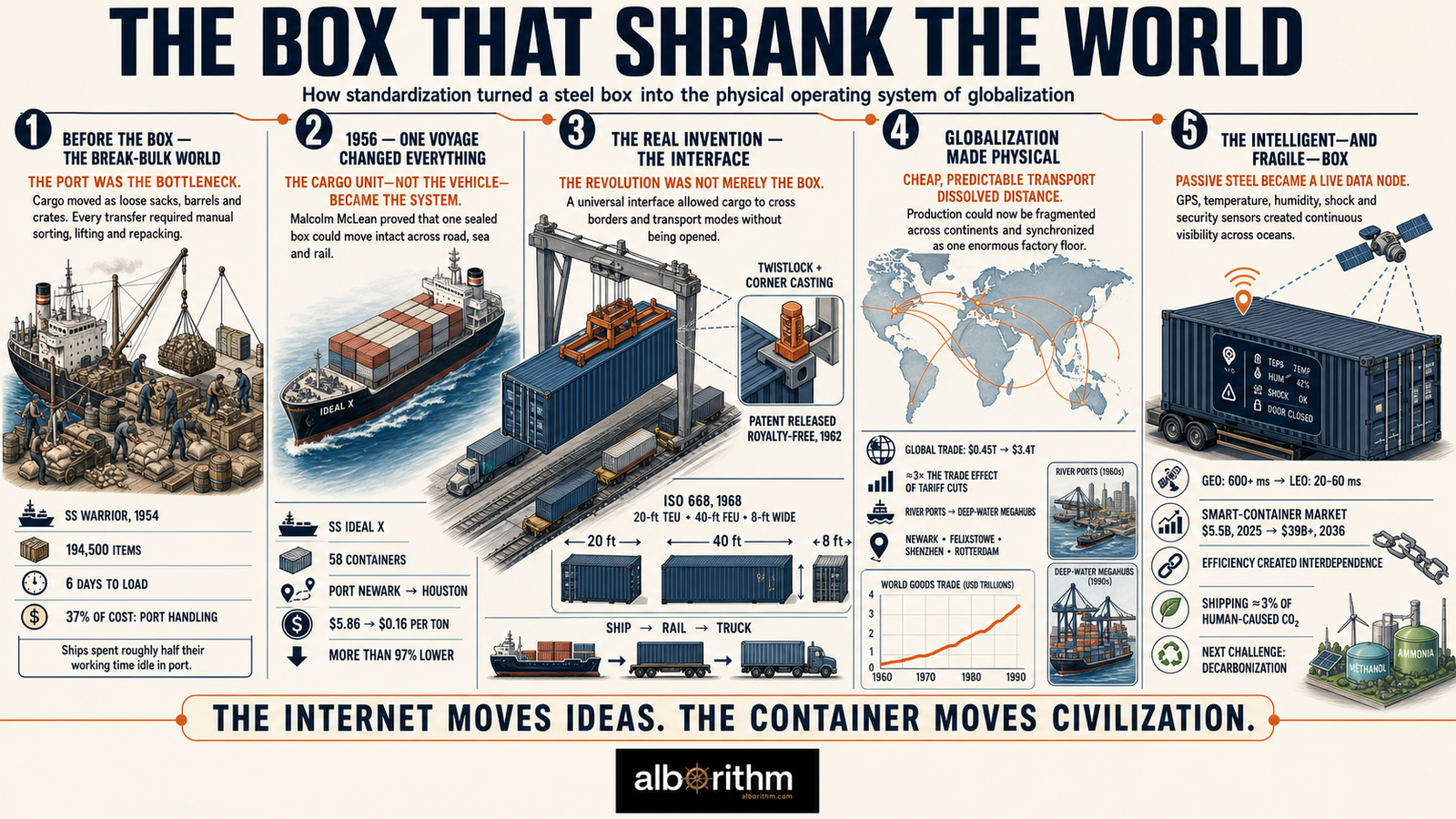
Before containerization, ships carried “break-bulk” cargo: loose sacks, barrels, crates and individual packages that had to be manually loaded, sorted and repacked at every transfer point. Ships often remained idle in port for days while dockworkers moved cargo piece by piece.
That system changed in 1956 when Malcolm McLean’s SS Ideal X sailed from Port Newark to Houston carrying 58 standardized containers. The experiment helped reduce cargo-handling costs by more than 97 percent and demonstrated the power of moving goods inside one sealed unit.
The true innovation, however, was not simply the steel box. Standard dimensions, reinforced corner castings and the twistlock created a universal transport interface. A container could move seamlessly from cargo ship to freight train to truck without being opened—a system now known as intermodal transportation.
Containerization reshaped global trade routes, transformed historic ports and allowed manufacturing to spread across continents. Today, smart containers equipped with GPS, environmental sensors and satellite connectivity are turning physical cargo into real-time data.
This infographic explores the remarkable evolution of the shipping container—from the break-bulk era and the voyage of the SS Ideal X to ISO standardization, global supply chains and intelligent container technology.
Sometimes, a civilization-changing revolution arrives in the shape of an ordinary box.
Subscribe to alborithm
Get new documentaries, articles and podcasts directly in your inbox.