
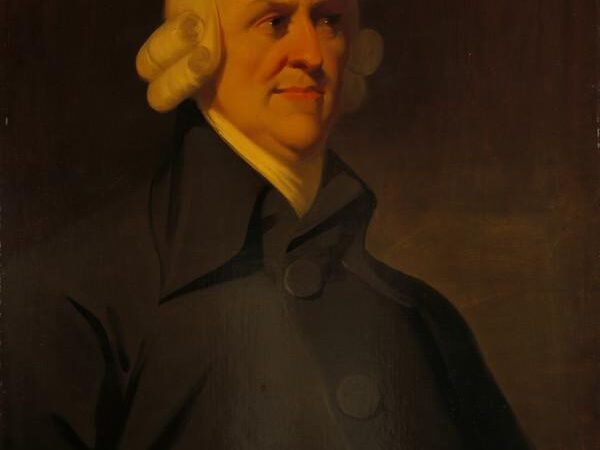
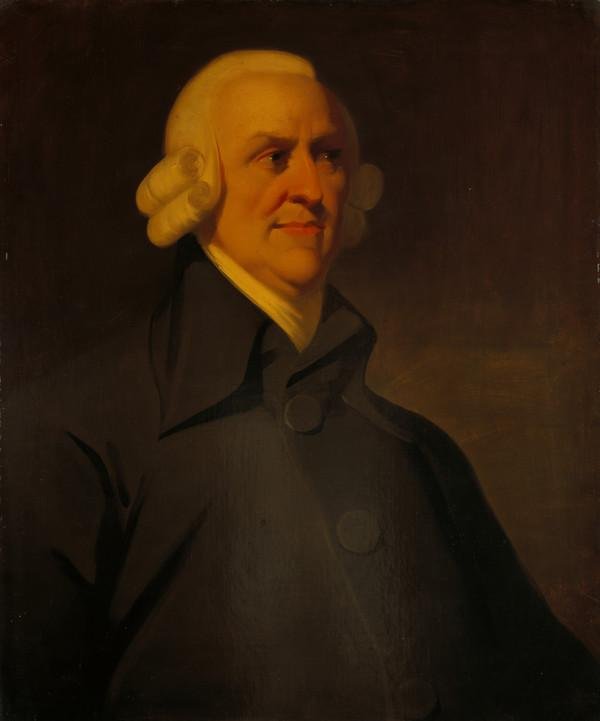
Adam Smith | First published 1776 | ALBORITHM | GREAT BOOKS & IDEAS
ALBORITHM Research & Editorial | Sources reviewed 16 October 2026
Two hundred and fifty years after its publication, Adam Smith’s masterpiece remains essential to understanding productivity, markets, trade, government and the political interests that can bend an economy to their advantage.
In 1776, Adam Smith asked his readers to imagine transporting 200 tons of goods between London and Edinburgh.
A ship sailing between London and Leith, the port serving Edinburgh, could accomplish the journey with six or eight men. Moving the same quantity by road, in the comparison Smith offered, required 50 wagons, 100 men and 400 horses.
He was not writing a history of shipping. He wanted to show why access to cheaper transport enlarges markets, why larger markets support more specialized work and why specialization can make an entire society more productive. An apparently mundane question about freight costs was connected to a much bigger one: what makes a nation wealthy?
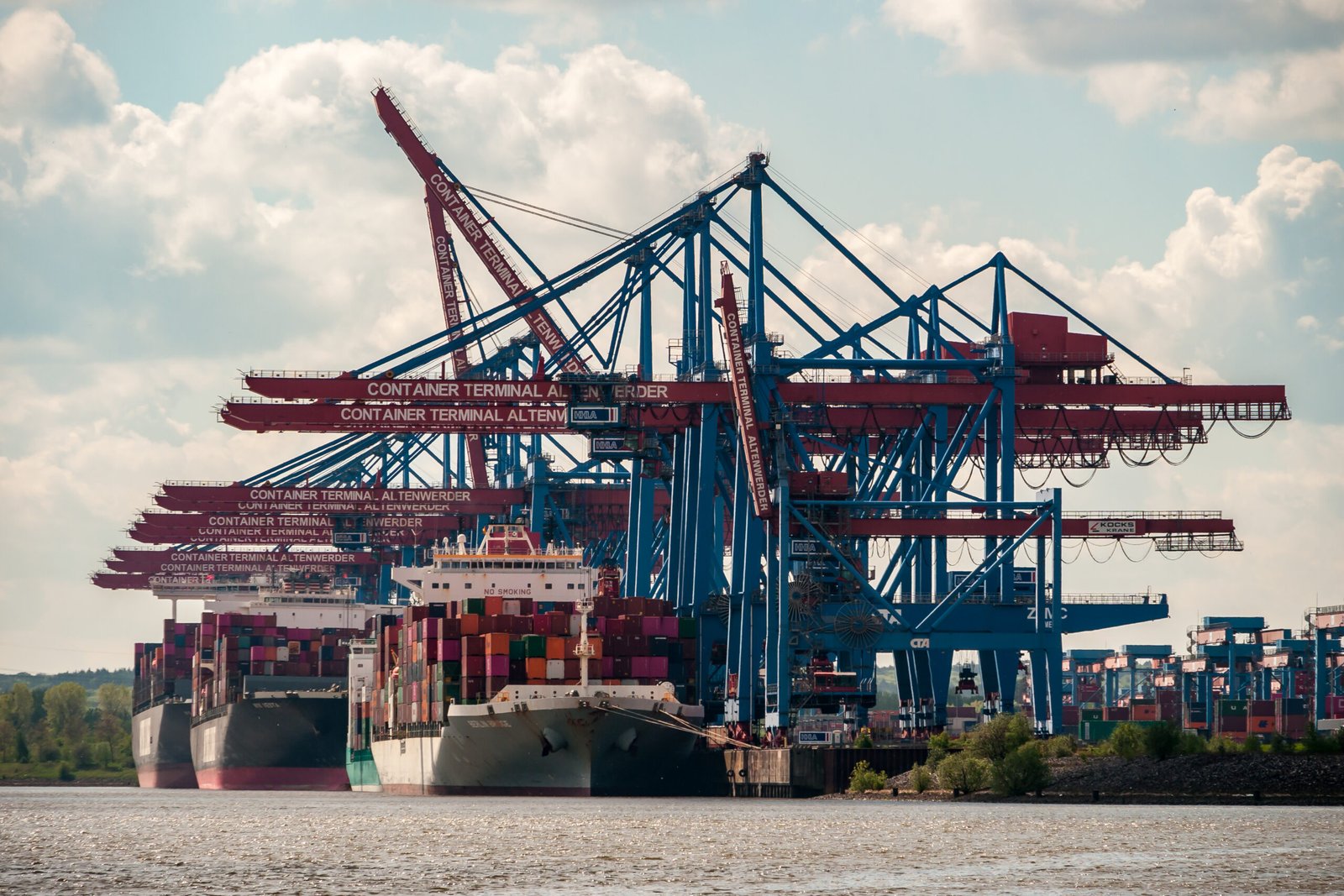
Today, cargo moves between continents on vessels carrying thousands of containers. Microchips, medicines and consumer goods pass through production networks that span multiple countries. Yet every global supply chain still confronts the problem Smith identified. How do people organize work and exchange so that limited resources create more of what society needs?
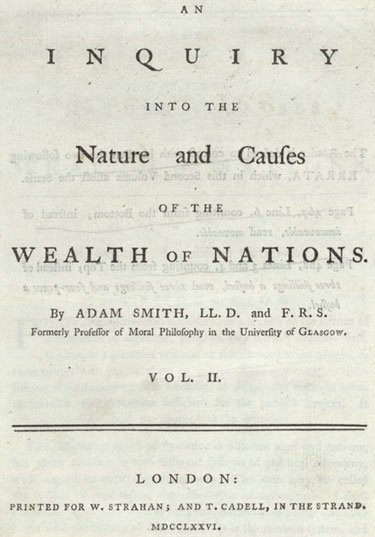
An Inquiry into the Nature and Causes of the Wealth of Nations, better known as The Wealth of Nations, was first published in London on 9 March 1776. Its 250th anniversary in 2026 provides a reason to read the work anew, not as a collection of famous slogans, but as an investigation of production, commercial power, public institutions and human welfare.
ALBORITHM | GREAT BOOKS | ISSUE 001
Watch and listen to The Wealth of Nations
One English video explainer and three source-grounded Deep Dive discussions.
Explore this analysis
- What did Adam Smith mean by the wealth of a nation?
- Five books, one investigation
- The pin factory and the power of specialization
- A freight comparison that anticipated global supply chains
- Markets, prices and the misunderstood invisible hand
- Prices, wages, profits and the distribution of prosperity
- Capital, saving and the foundations of growth
- Mercantilism, monopoly and the politics of empire
- Why Smith did not reject every restriction on trade
- The government Smith actually described
- What Smith could not foresee
- The Wealth of Nations in the modern global economy
- The lasting question after 250 years
What did Adam Smith mean by the wealth of a nation?
Much economic policy in Smith’s Europe operated on the assumption that a country’s strength could be measured by its stock of gold and silver, its export surplus or the privileges it secured for favoured merchants. Governments protected selected industries, imposed commercial restrictions and used colonial relationships to channel trade towards imperial interests.
Smith contested the premise. Money mattered as an instrument of exchange, but it was not the underlying source of prosperity. He began instead with what the people of a society could produce and obtain through their labour and trade. He was concerned with the flow of goods available to support life, not simply with bullion in a treasury.
This change of emphasis was fundamental. The economy was no longer chiefly a contest in which one state’s gains had to be purchased through another’s losses. Productive improvements and mutually beneficial exchange could expand the material possibilities available to many people at once.
That did not mean Smith believed every person would automatically share the gains. Wages, profits and rents were central to his analysis. The question of who benefited was part of the inquiry from the beginning.
A philosopher of morality as well as markets
Smith was born in Kirkcaldy, Scotland, in 1723. He studied at Glasgow and Oxford and later taught moral philosophy at the University of Glasgow. His earlier major work, The Theory of Moral Sentiments (1759), examined sympathy, conscience, moral judgement and the social foundations of conduct.
This matters because the familiar caricature of Smith as a prophet of greed obscures much of what he wrote. He recognized that self-interest motivates many economic transactions. He did not suggest that self-interest exhausts human nature or makes justice unnecessary.
A functioning commercial society depends upon expectations about honesty, law, security and the treatment of others. The merchant and the customer pursue different ends, but their dealings take place within institutions and moral conventions neither creates alone.
Smith was a philosopher trying to understand how society holds together, and how it can become more prosperous, when individuals act on different motives and possess very different degrees of power.
Five books, one investigation
The famous title conceals the work’s extraordinary range. Smith divided it into five books, moving from the organization of production to the obligations of government.
Editorial reading guide based on the original five-book structure. ALBORITHM graphic.
The architecture matters. Smith did not finish with a declaration that markets should replace all public institutions. He ended by considering defence, justice, infrastructure, education, taxation and public borrowing. A reading that ignores Book V misses a substantial part of his political economy.
The pin factory and the power of specialization
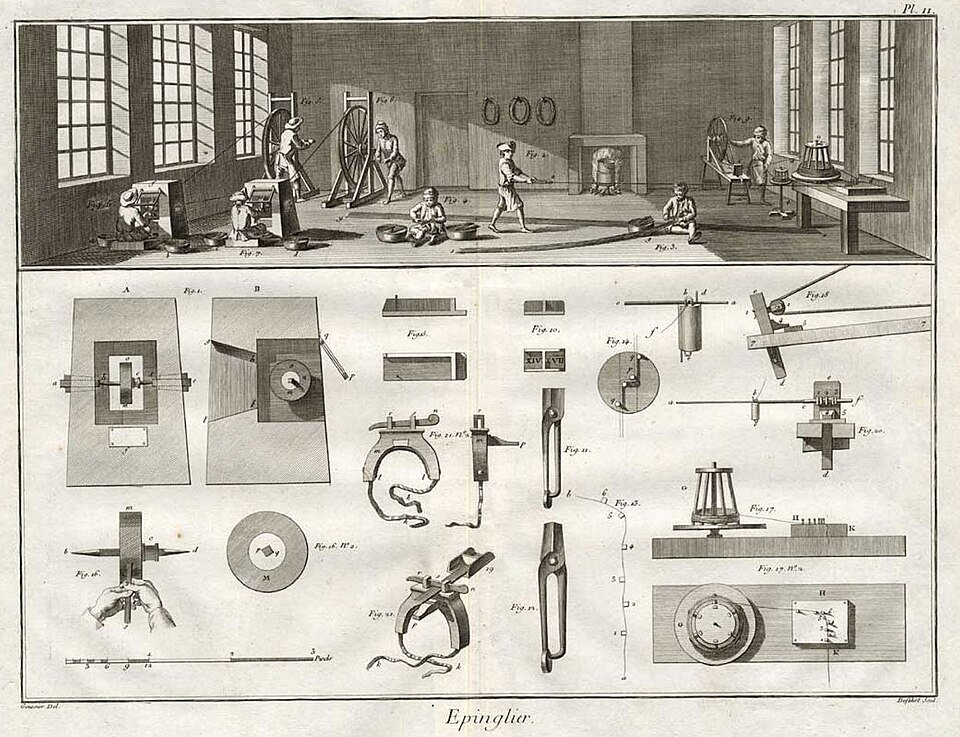
Smith opens Book I with an unlikely protagonist: a pin.
Making a pin involves many separate operations. Smith describes workers drawing wire, straightening it, cutting it, preparing a point, attaching the head and carrying out other tasks. In his illustrative workshop, ten people working with a division of labour could produce more than 48,000 pins in a day.
The figure is Smith’s historical account, not a productivity measurement that should be repeated as a modern scientific finding. Its analytical point is clear. A group of specialists can produce vastly more than the same people working separately on every operation.
Smith identified several mechanisms. Repetition improves dexterity. Workers waste less time changing tasks. Specialization also creates incentives to invent tools and refine processes.
From the workshop to the global factory, this remains a powerful explanation of productivity. Modern aircraft, pharmaceuticals, computers and automobiles depend on capabilities that no single worker and few individual firms possess in full.
But the celebrated pin factory is only half the story. Smith also recognized that specialization can narrow the intellectual life of a worker whose entire day is confined to repetitive operations. In Book V he argued for public attention to elementary education partly because extreme division of labour could weaken people’s wider capacities.
The gains in output were real. So were the human costs that an efficient production system might impose.
Why market size changes everything
Smith’s next insight was that specialization has a limit: the size of the market.
A craftsperson cannot devote every working hour to one very narrow operation unless enough buyers exist to support that occupation. Markets must be large enough to absorb specialized output. Greater access to customers, in turn, makes further specialization worthwhile.
This relationship helps explain why transport infrastructure affects productivity rather than merely the cost of delivery. An inland producer served by poor roads may be unable to reach a large enough market to justify specialized machinery. Better links to a river, port or railway can change the economics of the business itself.
The contemporary equivalent is a manufacturer whose production becomes viable only because suppliers and customers are connected internationally. Ships and ports are therefore not peripheral to Smith’s logic. They are among the mechanisms that make deeper specialization possible.
A freight comparison that anticipated global supply chains
Smith’s London to Leith example is one of the book’s most revealing passages. The same 200 tons of cargo could be moved by a relatively small ship’s crew or by a much larger land transport operation. He also recognized costs and risks on both sides, including the greater maritime insurance risk in his comparison.
Historical illustration from The Wealth of Nations, Book I, Chapter III. Figures describe Smith’s eighteenth-century comparison, not modern maritime or road freight productivity.
The example is specific to transport conditions in Smith’s time. It is not a modern cost ratio between shipping and trucking, nor evidence that every maritime route is cheaper than every land route today.
Its historical importance lies in how Smith joined transport economics to industrial development. Lower movement costs extend the reach of sellers and buyers. More extensive markets support specialization. Specialization encourages productive improvement.
He even asked his readers to consider the implausibility of moving ordinary cargo overland between London and Calcutta under the conditions of his era. Maritime connections permitted a scale of international commerce that land transport could not economically sustain.
The maritime link is still decisive. UN Trade and Development reports that approximately 80% of international merchandise trade by volume is carried by sea. The modern system relies on container terminals, bulk ports, inland connections, marine insurance, customs administration and contractual rules in addition to ships. Those institutions reduce the friction of exchanging goods over great distances.
A port is not only a gateway through which cargo passes. It can enlarge the market available to an entire industrial region.
For the longer historical development of these networks, see ALBORITHM’s The Architecture of Global Trade.
Markets, prices and the misunderstood invisible hand
The invisible hand is often treated as the entire argument of The Wealth of Nations. That interpretation overlooks both the book and the context in which the metaphor appears.
Smith’s account of exchange begins with a practical observation. People who trade usually hope to improve their own circumstances. A baker sells bread to earn an income; a customer buys it to eat. Neither needs to share the other’s final purpose for a transaction to take place.
Prices and competition can help coordinate these dispersed decisions. Changes in demand create incentives for producers to increase or reduce supply. Rival businesses may seek customers by improving products or lowering costs. Economic order can arise through interactions among people without a single authority specifying every transaction.
But Smith’s use of the invisible hand in Book IV, Chapter II occurs in a particular discussion of merchants’ preference for domestic investment and outcomes they did not deliberately seek. It was not a proof that all market outcomes are efficient, fair or socially beneficial.
Indeed, much of the book investigates the opposite problem. Merchants may seek monopolies, restrictions on competition or privileges granted by government. The advantage of a powerful business group can be incompatible with the interests of consumers, workers and other producers.
A profitable arrangement is not automatically a public benefit.
Nor is this merely an eighteenth-century issue. Contemporary debates about dominant digital platforms, corporate lobbying, competition law and concentrated supply chains concern the same question: when does the pursuit of private advantage encourage productive activity, and when does it restrict the opportunities of everyone else?
Prices, wages, profits and the distribution of prosperity
Smith examined the prices of goods and the income received by those involved in production. He distinguished wages for labour, profits on stock and rent derived from land. These categories allowed him to consider the competing interests present within commercial society.
His discussion of value was an important stage in the development of economic thought, but it was not the final word. Later economists revised the analysis of prices, scarcity, utility and production. Modern economic theory should not be read backwards into Smith’s text as though every later discovery were already there.
His treatment of workers deserves particular attention. Smith did not define national success only by the income of merchants or landowners. He linked the well-being of ordinary workers to the condition of society as a whole. In Book I, Chapter VIII, he declared:
No society can surely be flourishing and happy, of which the far greater part of the members are poor and miserable.
That sentence is a useful test of popular claims made in his name. A country may be commercially active, accumulate substantial capital and produce increasing output while leaving many of its people insecure or deprived. Smith’s own concern with wages and living conditions makes it difficult to equate aggregate commercial success with a complete account of prosperity.
Capital, saving and the foundations of growth
Production also requires resources to be advanced before a product is sold. Workers need equipment and materials. Merchants finance inventories. Enterprises invest in premises, tools and improved processes.
Book II examines the accumulation and employment of capital. Smith investigated how saving can support investment, enabling productive activity to expand over time. In a developing economy, improved production and expanding markets may reinforce one another as income and capital become available for additional enterprises.
His distinction between productive and unproductive labour reflected the intellectual and economic conditions of his century. It should not be imposed unchanged upon a modern economy, where services such as healthcare, education, software and research contribute in numerous ways to output and welfare.
What survives is the larger analytical question. Growth depends not merely on owning resources, but on institutions and incentives that encourage people to employ resources effectively over time.
Mercantilism, monopoly and the politics of empire
Smith’s criticism of mercantilism was as much political as economic.
He observed that commercial rules could be shaped to benefit particular merchants. Tariffs and exclusive privileges might enrich protected interests while raising costs for consumers, reducing competition and diverting resources towards activities that were profitable chiefly because government had sheltered them.
His critique grew sharper when he turned to empire. Colonial trading systems frequently served a narrow circle of beneficiaries, while the wider costs of military protection and imperial administration fell on society.
The East India Company presented an especially consequential example. A chartered commercial enterprise had acquired far-reaching political authority in India. Smith criticized arrangements that combined the incentives of merchants with the powers of sovereign government.
For Indian readers, this is central to understanding why the history of economic wealth cannot be written only from the perspective of trading companies’ profits. The relevant questions also concern coercion, taxation, political authority, who controlled market access and who paid for imperial expansion.
It would be misleading to turn Smith into a modern anti-colonial thinker. His arguments were developed within eighteenth-century assumptions and contained their own limitations. Yet he plainly challenged monopolistic colonial privilege. The University of Glasgow’s 2026 reassessment places these connections among commerce, empire and political influence at the centre of his work.
This is one reason Smith remains relevant to the study of political economy. The rules of a market are not always neutral. Powerful participants may try to write those rules to suit themselves.
Interpretive mechanism based on Smith’s critique in Book IV. It is not a quantitative causal estimate or a claim that every trade rule produces identical effects.
Why Smith did not reject every restriction on trade
Smith argued that many trade barriers were expensive ways to protect selected producers. He believed that freer exchange could allow buyers to acquire goods more economically and producers to find wider markets.
There was, however, an important qualification. In his discussion of Britain’s Navigation Acts, Smith accepted that national security could sometimes justify commercial restrictions even when they came at an economic cost.
The modern parallel is apparent. Governments weighing the security of energy supplies, shipping routes, advanced technology or essential medicines must consider more than the cheapest immediate source. Dependence can create strategic vulnerability.
Recognizing this problem is not a blanket argument for protectionism. It is a reminder that economic policy involves competing objectives. Trade measures should be examined for their real benefits, costs and beneficiaries, not defended solely through the language of either national self-sufficiency or unrestricted markets.
A further historical distinction matters. Smith helped lay the intellectual foundations of arguments for freer trade, but the formal theory of comparative advantage is associated with David Ricardo’s work in 1817. They should not be credited with the same contribution.
The government Smith actually described
A great deal of The Wealth of Nations concerns the public institutions without which commercial society would struggle to function.
Book V examines national defence, the administration of justice and public works. Roads, bridges, canals and harbours appear as facilities that can serve commerce. Smith also addressed education, taxation and public debt.
His proposals did not amount to today’s welfare state. He often considered user charges, local arrangements and mixed forms of financing. But neither did he imagine that prosperity could be sustained in a legal and institutional vacuum.
A society needs security, predictable rules and mechanisms for settling disputes. Infrastructure may require investments whose benefits extend beyond the people who finance them. Education matters both for economic capability and for the lives people are able to lead.
Smith’s four well-known principles of taxation concern fairness, certainty, convenience and economy in collection. They show a thinker interested not only in whether government should raise revenue, but also in how public obligations can be designed and administered.
His analysis of public debt added another caution. Governments can incur costs today that are transferred to taxpayers later, especially through wars and fiscal commitments made for political reasons.
Taken together, these discussions leave little room for the claim that Smith equated sound government with the disappearance of government.
A selective reading guide, not an exhaustive list of all public responsibilities discussed by Smith.
What Smith could not foresee
A book published in 1776 cannot be expected to resolve the economics of the twenty-first century.
Smith did not witness modern multinational companies, containerization, large-scale financial derivatives, digital platforms or the environmental consequences of industrial production on their present scale.
His theories of value and growth were later revised. His assumptions about historical development reflected the perspective of his own society. His treatment of colonialism, slavery and the unequal experiences of men and women requires critical reading and additional scholarship.
Modern environmental economics also asks questions that Smith could not systematically answer: who pays for pollution, how should scarce ecological resources be valued, and what happens when market prices exclude damage imposed on others?
These limitations do not make the book obsolete. They establish the difference between a foundational work and a complete contemporary textbook.
There is also a tension worth carrying forward. The same specialization that produces efficiency can create fragility when essential components come from a handful of suppliers. A low-cost supply chain can prove unexpectedly expensive when a critical route closes. Market size can encourage extraordinary innovation while permitting dominant firms to accumulate disproportionate influence.
Smith provided tools for examining these questions. He did not settle them in advance.
The Wealth of Nations in the modern global economy
Consider a semiconductor that is designed in one country, fabricated in another, packaged in a third and installed in a vehicle assembled elsewhere. Its production depends on a complex division of labour, investment, transport networks, specialized knowledge and markets large enough to justify enormous fixed costs.
The process would be recognizable to Smith in its economic logic, though not in its technology.
Now imagine a geopolitical shock that threatens access to one specialized supplier. Firms that previously optimized production for cost must consider redundancy, inventory and alternative locations. National governments face questions about strategic dependence and industrial policy.
Or consider a major port. Better connections can expand the market for nearby producers and attract new investment. But the value of that connectivity depends on customs performance, inland infrastructure, reliability, labour conditions, legal rules and the distribution of gains.
Or consider a fast-growing economy where wealth accumulates rapidly while a significant share of workers remains vulnerable. Output is rising, but its social consequences demand separate examination.
Across these examples, Smith’s enduring value is not that he supplies a simple policy instruction. He teaches readers to examine the machinery of prosperity: production, incentives, exchange, institutions, power and the allocation of benefits.
For a companion investigation into the longer history of ownership and wealth, read ALBORITHM’s The Architecture of Wealth.
The lasting question after 250 years
In Smith’s time, wealth could be imagined as treasure guarded in a royal vault. Today it may appear as national income, financial assets, industrial capacity or the market value of large corporations. Each measure reveals something; none alone settles what it means for a society to flourish.
Smith began by asking readers to look at what people could produce and consume. He then examined the division of labour that raised output, the trade that enlarged markets, the investment that enabled expansion and the institutions that governed it all.
He also examined the merchants who sought privilege, the workers whose conditions mattered and the empires that concentrated economic power.
These strands belong together. The Wealth of Nations is not simply an argument for self-interest. It is an inquiry into the arrangements through which private decisions become public economic outcomes.
That is why its original question remains so demanding.
How can a society become more productive without allowing prosperity to be captured by the few who control its markets and institutions?
After two and a half centuries, Adam Smith is still worth reading because he insisted that this question required investigation rather than a slogan.
Frequently asked questions
What is the central argument of The Wealth of Nations?
Smith argued that a nation’s prosperity rests on its capacity to produce and obtain useful goods, supported by specialization, capital, exchange and appropriate institutions. He opposed treating stocks of gold and silver as the essence of national wealth.
What is the invisible hand in Adam Smith’s theory?
It is a metaphor Smith used in a specific discussion of unintended outcomes associated with merchants’ investment decisions. It is not a general guarantee that every private action serves society or that markets cannot fail.
Did Adam Smith invent economics or free trade?
No. Markets and economic thinking predate Smith. His achievement was to bring production, prices, distribution, trade, history and public policy into an unusually comprehensive study of political economy. David Ricardo later developed the theory of comparative advantage.
Did Smith oppose government intervention?
No. He argued against many commercial privileges and restrictions, while discussing defence, justice, infrastructure, education, taxation and public debt as matters of public responsibility. He also recognized national security as a possible reason to restrict trade.
Why should readers interested in shipping and supply chains study the book?
Smith connected cheap water transport to larger markets and greater specialization. That relationship remains fundamental to global manufacturing, ports, maritime logistics and international trade.
Read the original work and research sources
- Primary text: Adam Smith, An Inquiry into the Nature and Causes of the Wealth of Nations, Project Gutenberg edition. Read Book I, Chapters I, III and VIII; Book IV, Chapter II; and Book V for the passages discussed here.
- Historical context: University of Glasgow, The Wealth of Nations at 250, including The Nature of Wealth, The Causes of Wealth and The Politics of Wealth.
- Moral philosophy: Stanford Encyclopedia of Philosophy, Adam Smith’s Moral and Political Philosophy.
- Maritime trade: UN Trade and Development, Review of Maritime Transport. The figure of approximately 80% refers to international trade in goods by volume, not value.
- Authoritative edition context: University of Glasgow, Key Editions of Smith’s Works. The 1976 Glasgow edition is a scholarly edited text; its modern editorial material is not automatically public domain.
- Specialization and contemporary markets: Diane Coyle, Adam Smith’s Division of Labour in Today’s World of Global Markets, National Institute of Economic and Social Research.
- Empire and monopoly: Mark Donoghue, Adam Smith on the Wretched Spirit of Monopoly in the East Indies Trade, Journal of the History of Economic Thought.
- Trade policy nuance: Adam Smith Works, Book IV, Chapter II, including Smith’s discussion of navigation restrictions and security.
- Government and taxation: The Wealth of Nations, Book V, Chapter II, primary text on taxation.
Editorial note: This is an original critical interpretation, not a reproduction of the full book. The primary work is in the public domain in many jurisdictions, but rights in modern editions, annotations, translations, photographs and audiovisual material must be assessed separately.
Subscribe to alborithm
Get new documentaries, articles and podcasts directly in your inbox.