
ALBORITHM | BOOKS THAT SHAPED THE WORLD | GREAT BOOKS 003
A country can possess factories, skilled workers and productive capacity, yet still fall into decline. Banks retreat from lending. Businesses stop investing. Prices and debt burdens turn against people who had planned for an entirely different future. How can an economy contain so much possibility and still be held back by the system that finances it?
ALBORITHM | GREAT BOOKS | ISSUE 003
Watch and listen to A Treatise on Money
One English video explainer and three source-grounded Deep Dive discussions.
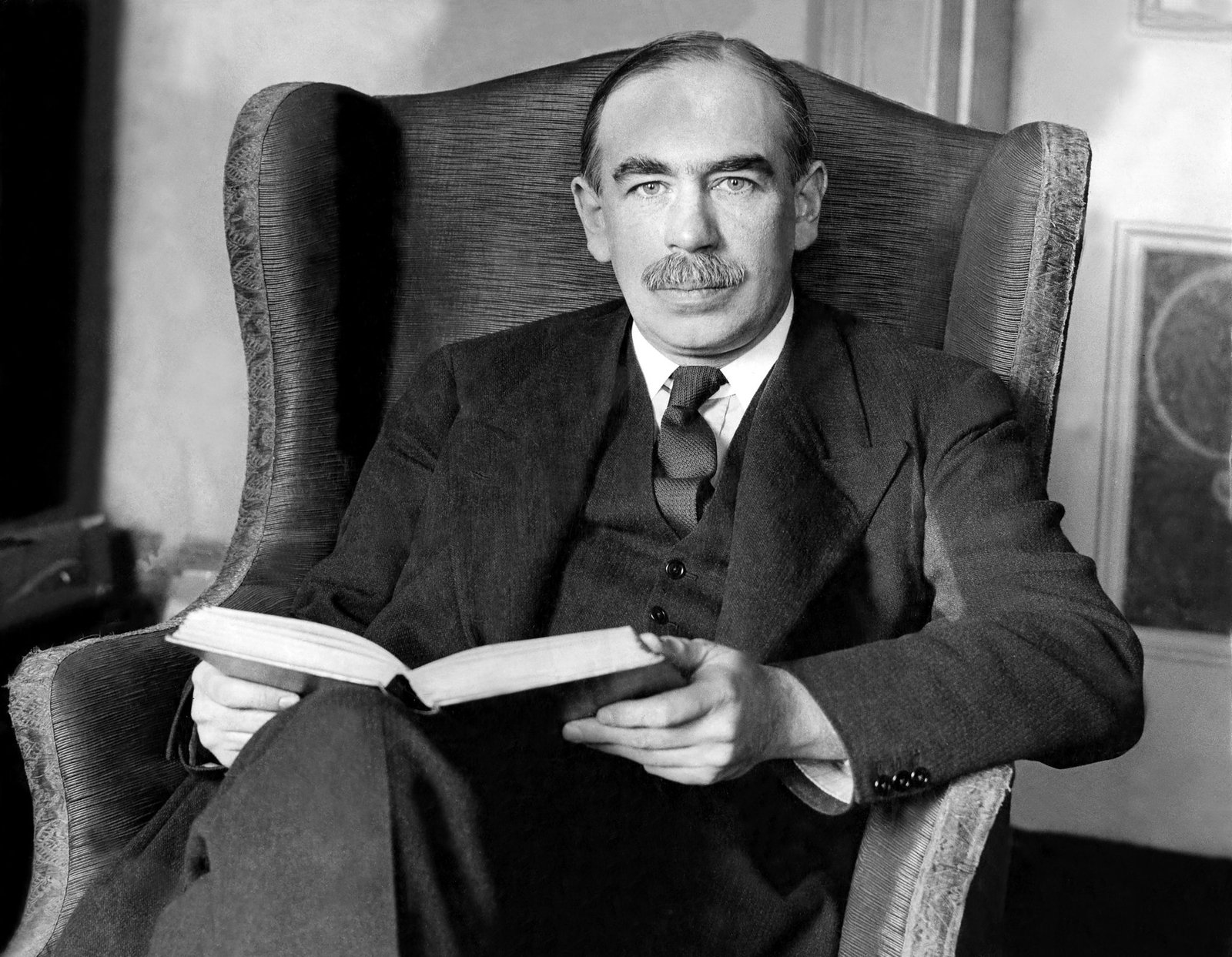
In 1930, John Maynard Keynes published a study that attempted to explain how money, credit, prices and investment interact. The two-volume A Treatise on Money is less famous than his later General Theory, but it belongs to the history of the intellectual struggle to understand banking and economic instability.
Keynes did not write a simple guide to personal finance or a formula for anticipating markets. He asked how a monetary economy works when millions of decisions are taken separately and institutions must manage their collective consequences. His answers were bold, contested and, in important respects, subsequently revised by Keynes himself.
Explore the analysis
- The world in which Keynes wrote
- Before the Keynes of the textbooks
- Inside the Treatise: seven Books, two volumes
- Why banking changes the economic story
- A crisis that deepened after the book appeared
- Why Keynes eventually changed his mind
- What the critics saw, and where the Treatise falls short
- From the gold standard to today’s monetary economy
- Why this matters for India, global trade and investors
- What survives the century
- Frequently asked questions
- Sources and further reading
The world in which Keynes wrote
The financial world of 1930 was not the one familiar to contemporary investors or central bankers. Much of international monetary policy was shaped by attempts to preserve or restore gold-standard exchange rates after the First World War. Governments sought monetary credibility even when defending the exchange rate placed pressure on domestic production, wages and employment.
Britain had returned to gold in 1925 at its pre-war parity. Keynes opposed the decision, fearing the economic cost of an overvalued currency. The Wall Street crash of October 1929 introduced another shock. But the global depression unfolded in stages, with deeper banking crises and Britain’s departure from gold still ahead when the Treatise appeared.
This sequence matters. Keynes was not writing with hindsight about the entire Great Depression. He was attempting to explain a monetary system as its vulnerabilities were being exposed. His subject was larger than a market crash: how could a sophisticated economic system, capable of creating wealth, turn its financial arrangements into a source of instability?
Before the Keynes of the textbooks
John Maynard Keynes (1883–1946) was already an established economist and public intellectual. In The Economic Consequences of the Peace (1919), he had challenged aspects of the postwar settlement. In A Tract on Monetary Reform (1923), he examined inflation, deflation and the objectives of monetary policy. The two-volume A Treatise on Money, published by Macmillan in London in 1930, was a much larger intellectual undertaking.
It is tempting to read the Treatise as an early version of The General Theory of Employment, Interest and Money (1936). That is a mistake. The earlier work asks how money, banking, prices and investment interact. The later book develops a substantially revised theory of output and employment. Understanding the difference is essential to understanding Keynes himself.
Indeed, some of the most instructive passages in the 1930 work are not ideas that became permanent doctrine. They reveal an economist trying to build an explanation, finding difficulties, and subsequently changing course.
Inside the Treatise: seven Books, two volumes
Volume I, The Pure Theory of Money, contains Books I to IV. Volume II, The Applied Theory of Money, contains Books V to VII. Rather than reducing hundreds of pages to a few slogans, it is worth following the path of the argument.
Book I. The Nature of Money
Keynes begins with a deceptively difficult question: what is money? His distinction between money of account, money proper and bank money points toward an economy in which payments depend heavily on claims recorded on bank balance sheets. Bank deposits are not an incidental convenience. They are part of the monetary structure through which purchasing power moves.
This is why a bank cannot be understood simply as a safe holding place for existing notes and coins. Its lending, deposit and liquidity relationships matter to the quantity and use of monetary purchasing power. Keynes’s historical categories are not identical to modern banking regulation, but his insistence on examining institutions remains important.
Book II. The Value of Money
What does it mean for money to lose purchasing power? Different goods, wages and assets can change in price at different speeds. Constructing an index is not merely a matter of choosing a mathematical formula. It requires deciding which transactions and which conception of purchasing power the index is meant to represent.
Changes in money’s value also change the real burden of contracts. Rising prices can erode the purchasing power of fixed incomes. Falling prices can make nominal debts harder to discharge. Monetary instability affects debtors and creditors differently, even while everyone uses the same currency.
Book III. The Fundamental Equations
This is the analytical centre of the first volume. Keynes tries to connect prices and entrepreneurial profits with the relationship between saving and investment. He uses specially defined concepts of income and profit in attempting to explain how divergence between plans can generate monetary disequilibrium.
For a modern reader, caution is indispensable. Keynes’s categories are not the same as today’s national-income accounts. It would be wrong to claim that saving and investment are simply unequal in modern aggregate accounting. His question was about adjustment, incentives and the consequences of decisions that do not coordinate as intended.
The fundamental-equations framework was an ambitious attempt to solve that problem, but Keynes later abandoned much of this apparatus. The historical value of the theory does not require presenting it as a settled account of economic behaviour.
Book IV. The Dynamics of the Price Level
Changes in credit and spending seldom reach every sector simultaneously. Keynes examines the movement of money through industrial and financial circulation, the effects of interest-rate adjustments, and the behaviour of a credit cycle. A decision that appears prudent for a bank or a business may have consequences elsewhere in the economic system.
Credit expansion can sustain investment, but excessive expectations can be followed by retrenchment. Once firms postpone expenditure, suppliers lose business, confidence deteriorates and lenders become more cautious. Keynes was seeking to explain how these processes develop rather than treating movements in money and prices as a single mechanical relationship.
Book V. Monetary Factors and Their Fluctuations
In the second volume Keynes turns toward observed monetary relationships. He examines the composition of deposits, reserves and the circulation of money, asking how they vary across time and institutions. A measure of currency alone does not reveal all the conditions shaping payments, lending and the financing of production.
Today’s digital transfers and bank balance sheets are very different from those of 1930. The connection is methodological: serious monetary analysis must study the institutions and transactions beneath the headline aggregates.
Book VI. The Rate of Investment and Its Fluctuations
Investment is not one undifferentiated activity. An enterprise may invest in fixed equipment, finance inventories, or hold liquid resources while waiting for conditions to improve. These decisions respond differently to costs, expectations and credit availability.
A manufacturer delaying a new plant may be acting rationally. Yet widespread postponement can depress orders for equipment, construction and materials. Decisions about future productive capacity have consequences for income and business activity today. Keynes’s analysis of capital and investment fluctuations makes that connection visible.
Book VII. The Management of Money
The final Book confronts the practical problem. If monetary arrangements can amplify economic disturbances, how should authorities manage them? Keynes examines interest rates, central-bank reserves, the banking system and the international gold-standard framework.
The central dilemma concerns the tension between domestic economic conditions and external monetary commitments. Defending an exchange rate may demand measures that are painful for domestic borrowers and producers. Relaxing those measures may threaten exchange-rate confidence. Keynes’s international perspective is especially valuable because national choices cannot always be judged without considering how currencies and capital movements connect economies.
Why banking changes the economic story
Imagine a profitable-looking manufacturer seeking a loan to expand production. A bank approves the borrowing, and the business acquires spending power that it uses to pay equipment makers, builders and workers. The transactions affect several balance sheets at once. In such a system, credit conditions influence real decisions about investment and employment.
Now imagine that the bank becomes cautious, perhaps because its depositors seek liquidity or because it anticipates losses. The manufacturer postpones expansion. Equipment suppliers lose orders. A decision inside the financial system becomes an event in the productive economy.
This does not mean every contraction in lending necessarily causes a depression. It shows why money cannot always be treated as an inert unit in which otherwise independent transactions happen to be measured. The connections among credit, expectations, spending and production need their own analysis.
A crisis that deepened after the book appeared
The economic disaster intensified after 1930. In the United States, successive waves of banking distress weakened confidence and impaired financial intermediation. Britain left the gold standard in September 1931. These events were not available to Keynes as completed historical evidence when he finished the original Treatise.
They nevertheless illuminate the urgency of the questions he was asking. What happens when lenders and depositors lose confidence? How do monetary restrictions interact with debt and falling prices? What can national authorities do when international commitments narrow the range of available options?
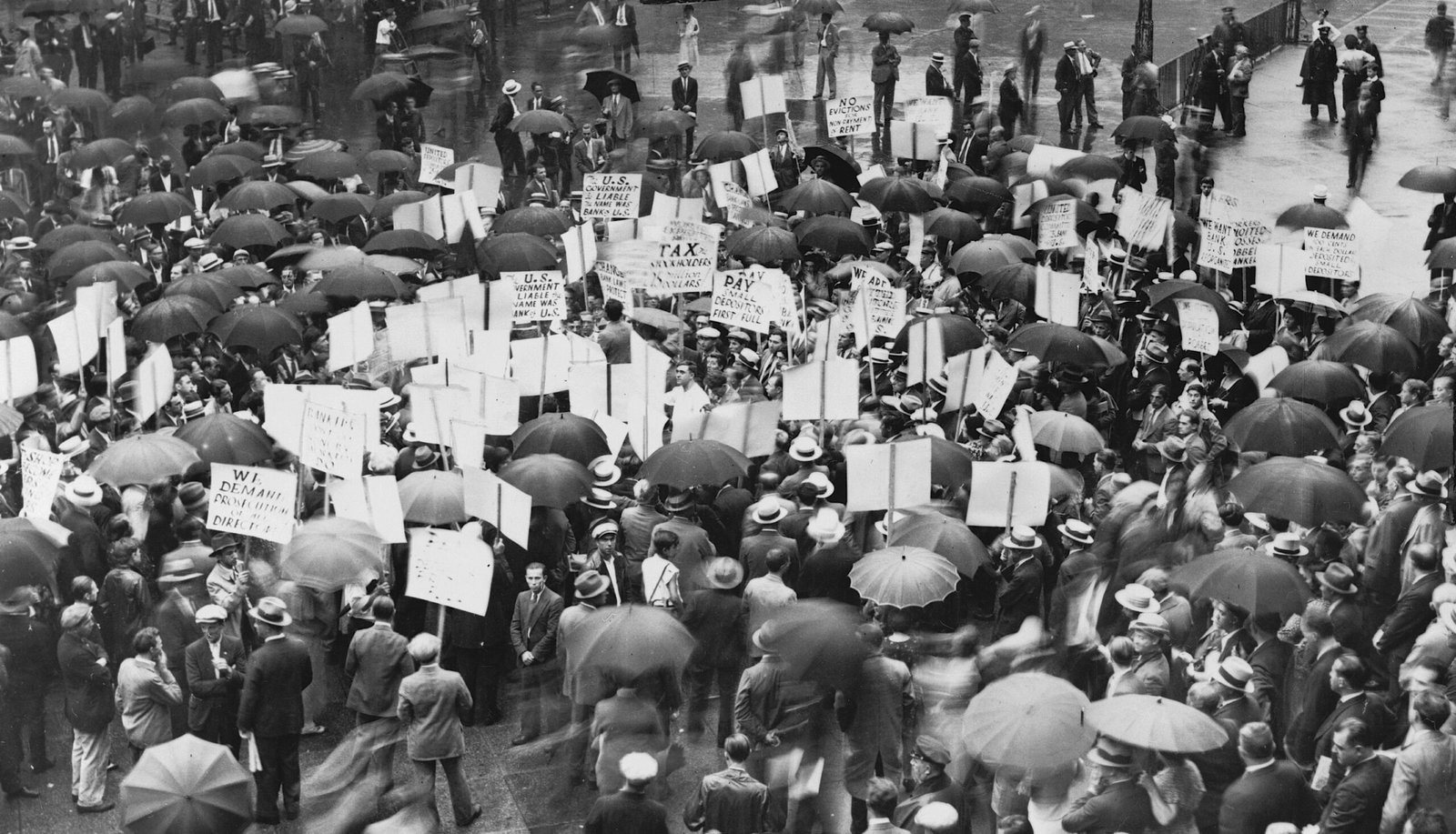
A historical photograph from 1931, reproduced below, shows depositors outside the failed Bank of United States in New York. It documents the subsequent crisis, not a scene Keynes could have used as evidence when the book first appeared.
Why Keynes eventually changed his mind
The history of economics becomes misleading when major books are presented as final statements of permanent truth. The Treatise is especially important because its author subsequently revised central aspects of his analysis.
In 1936, The General Theory shifted the centre of inquiry toward employment, output, effective demand and the possibility of enduring underemployment. Its treatment of saving and investment and its role for income adjustment differed materially from the 1930 fundamental-equations framework.
The earlier work should therefore be read on its own terms. It is not a compressed or preliminary textbook of the later theory. It shows Keynes wrestling with the problems that prompted further intellectual development. That movement from one model to another is part of the book’s historical significance.
What the critics saw, and where the Treatise falls short
Keynes’s peers did not greet the Treatise with unanimity. Friedrich Hayek challenged elements of its theory of capital and monetary disturbances. Other economists disputed the consistency of Keynes’s definitions and the behaviour implied by his equations. These were substantive disagreements about how production, prices, banking and investment should be analysed.
One criticism is that the fundamental-equations apparatus can obscure what is being measured. A second is that treating the monetary system at a high level of aggregation may miss differences in the timing, composition and structure of investment. A third is practical: policymakers do not observe every relevant decision or expectation, and interventions can have uneven effects.
Nor can the gold-standard world of 1930 be translated directly into modern floating-exchange-rate systems. Financial regulations, capital mobility, payment technologies and central-bank mandates have changed. Some Keynesian insights remain relevant; some particular arguments were superseded or heavily disputed.
A fair reading credits the analytical ambition without pretending that every proposition survived criticism.
From the gold standard to today’s monetary economy
Modern central banks face different institutional rules, but many of the underlying questions remain familiar: how do changes in policy rates reach borrowers, businesses and households? How do changes in financial confidence affect spending? How do exchange rates and international funding conditions constrain national decisions?
The Bank of England’s modern explanation of money creation emphasizes that lending by commercial banks creates matching deposit balances. This is a useful comparison with Keynes’s interest in bank money, not proof that the 1930 Treatise anticipated every detail of contemporary practice.
Similarly, the movement from a gold-standard world to modern monetary frameworks did not eliminate trade-offs. Price stability, financial resilience, growth and external conditions can still be difficult to balance, although the mandates and instruments available to policymakers vary by country.
Why this matters for India, global trade and investors
Consider an Indian manufacturer planning to import machinery and expand a factory. The decision depends on expected demand, lending conditions, interest costs and the price of imported equipment. Currency movements and international capital conditions can change those calculations, even if the factory’s physical capacity remains unchanged.
For shipping and global trade, a similar relationship operates through trade finance, working capital and confidence in international payments. A shipment can be commercially viable yet difficult to finance when banks become more cautious. Financial conditions are part of the infrastructure that makes trade possible.
Investors can draw a useful discipline from Keynes’s questions. Company fundamentals are not isolated from the monetary environment. Borrowing costs, credit availability and financial conditions can influence business investment, profits and asset valuations. But A Treatise on Money is not an asset-pricing formula or a trading strategy. Understanding a mechanism is not the same as forecasting a security’s next return.
What survives the century
The Treatise’s value lies less in the survival of its specific equations than in the seriousness of its inquiry. It treats banking as part of the monetary structure, investment as a fluctuating economic decision, and national monetary policy as inseparable from international conditions.
It also reminds readers that progress in economics involves disagreements and revisions. Keynes published an ambitious theory in 1930, confronted substantial criticism and developed a different framework six years later. The intellectual sequence matters as much as any single proposition.
The book cannot settle today’s debates about central banks, inflation or financial crises. It can help readers recognize why those debates are so difficult, and why the organization of money remains central to the organization of prosperity.
Frequently asked questions
What is A Treatise on Money about?
It is Keynes’s 1930 two-volume analysis of money, bank credit, prices, saving and investment, monetary fluctuations and national and international monetary management.
How is the Treatise different from The General Theory?
The Treatise focuses on money, prices, banking and investment disturbances through its own equations. The General Theory (1936) develops a revised approach to output, employment and effective demand. The two books should not be conflated.
Is the Treatise useful for investors?
It develops an understanding of monetary conditions and business investment. It is not a forecasting model, stock-selection method or investment recommendation.
Sources and further reading
Primary work: John Maynard Keynes, A Treatise on Money, Volume I, The Pure Theory of Money, and Volume II, The Applied Theory of Money (London: Macmillan, 1930). Original editions and library records are cross-checks; scans and OCR remain under production QA.
Continue exploring Great Books
Subscribe to alborithm
Get new documentaries, articles and podcasts directly in your inbox.