
ALBORITHM | BOOKS THAT SHAPED THE WORLD
One naval battle helped decide the fate of the American Revolution. A century later, a naval historian argued that the same force had shaped the fortunes of empires. His question still follows every ship across the ocean: who can protect the routes on which prosperity depends?
Original independent book analysis | Alfred Thayer Mahan (1840–1914) | First published 1890 | Maritime history, economics and geopolitics
The battle that revealed an invisible frontier
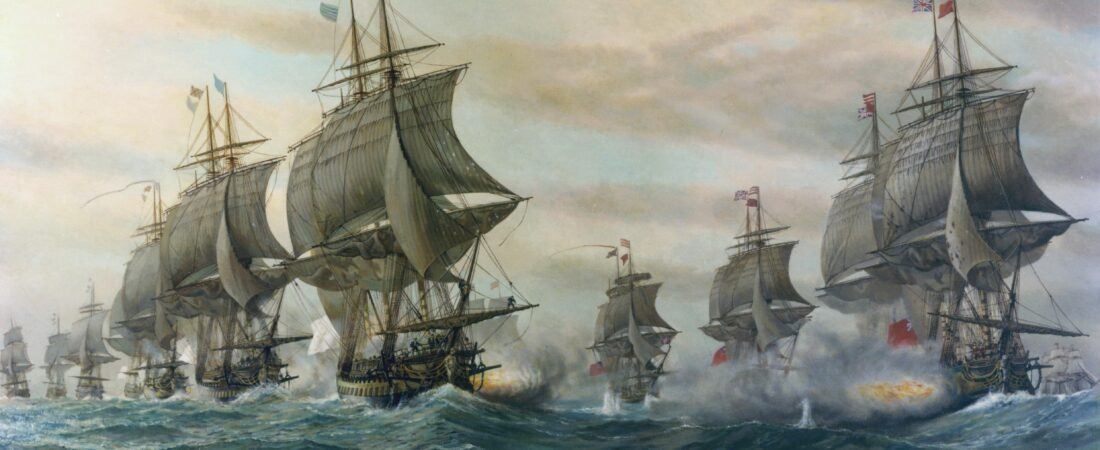
On 5 September 1781, French and British warships fought near the mouth of the Chesapeake Bay. George Washington was not commanding either fleet. No American warship took part. Yet the outcome helped decide the future of American independence. The French squadron under the Comte de Grasse prevented the British from regaining control of the approaches to Virginia. Weeks later, British troops under Lord Cornwallis surrendered at Yorktown.
The contest on land could not be separated from the contest at sea. The ability to reinforce an army, move troops, deliver provisions or escape a siege depended upon a maritime route being open when it was needed. That was the larger lesson revealed by the fighting off the Virginia Capes: a coastline could become a trap when the water beyond it was controlled by an opponent.
ALBORITHM | BOOKS THAT SHAPED THE WORLD
Watch the Video Explainer and Listen to the Deep Dives
Explore The Influence of Sea Power upon History through one English video explainer and three in-depth podcast discussions, in English, Hindi and Bengali.
Independent explanatory analyses of Alfred Thayer Mahan’s original work.
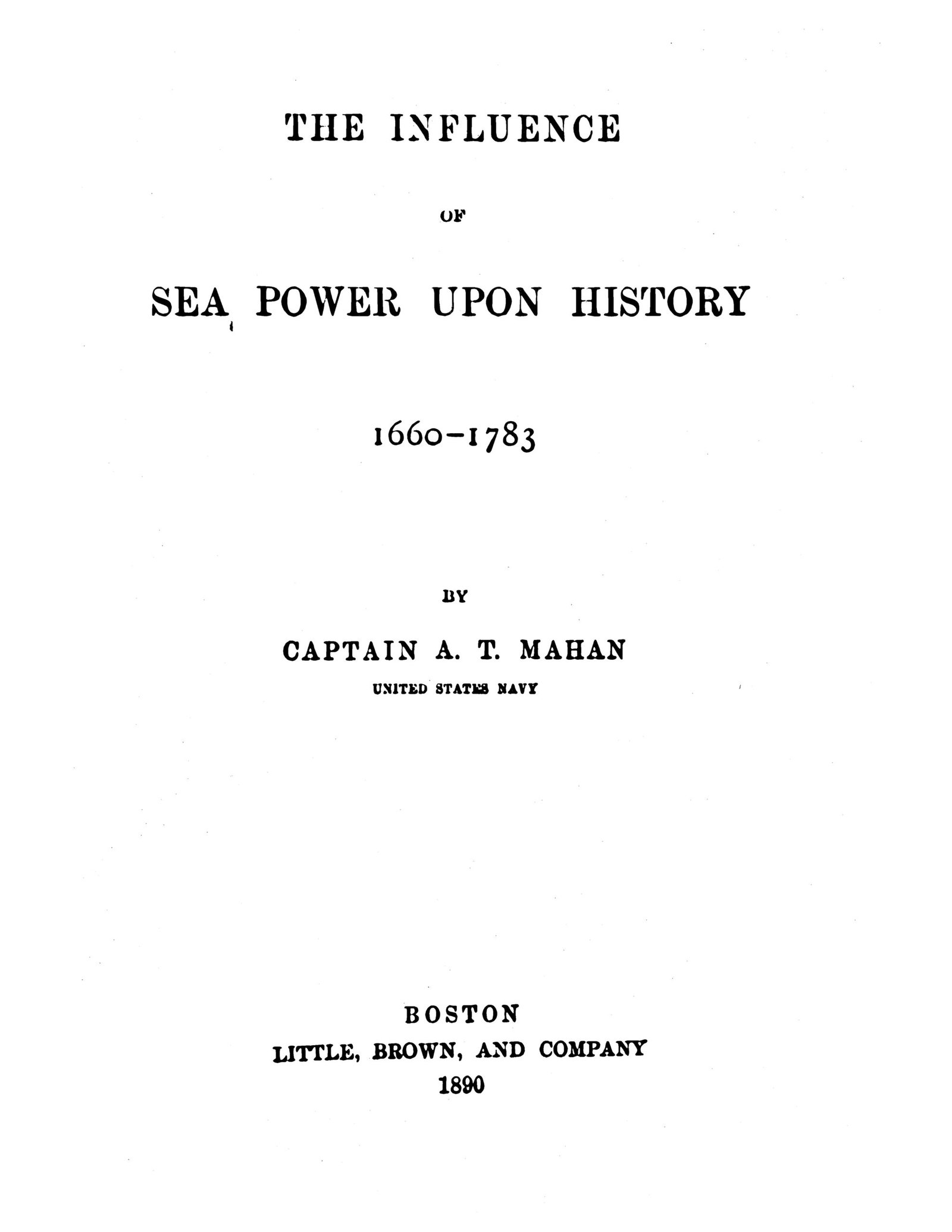
More than a century afterward, an American naval officer made this relationship between maritime access and national power the central subject of a remarkable book. The Influence of Sea Power upon History, 1660–1783, published in 1890, was not simply a catalogue of battles. It was an attempt to explain why trade, ships, geography, finance, overseas stations and political choices had repeatedly determined the strength of states.
Its author was Alfred Thayer Mahan, a United States naval captain and historian whose work would become an important point of reference in debates about navies and foreign policy. The book’s influence travelled well beyond military classrooms. Its argument also raises a question of particular interest to anyone who works with ports, commercial shipping, trade, international finance or geopolitics: what allows a maritime economy to flourish, and how vulnerable is that prosperity when the sea becomes contested?
A book about more than battleships
For Mahan, naval strength was inseparable from an economic system. A country needed the productive capacity to create goods, shipping to carry them, access to markets and ports, and the means to protect its maritime connections. Warships were part of the picture, but they did not create prosperity out of nothing. They defended, contested or interrupted the commercial system on which national strength depended.
This is the distinction that disappears when his ideas are reduced to a single proposition about big fleets. In the opening chapter, Mahan traces a chain linking production, shipping and overseas positions. The meaning of those positions has changed since his imperial age, but the underlying logistical insight is clear: ships at sea depend on facilities, supplies, maintenance, information and secure access. Naval forces do, too.
Mahan did not think geography alone settled the matter. He identified six broad conditions affecting a nation’s maritime development: geographical position; the character of its coast, harbours and physical environment; territorial extent; population; what he called the character of its people; and the policy and institutions of government. The last two must be read with caution. His categories reflect the assumptions of a nineteenth-century author and are not timeless measurements of national worth. His more durable insight is that geography creates possibilities while institutions, investment and political choices shape what a society does with them.
It is easy to see why this framework attracted attention. A natural harbour is useful, but without industries, skilled workers, inland transport, commercial institutions and viable shipping services, location alone does not guarantee influence. Equally, a substantial merchant fleet is vulnerable if a state cannot secure its operating environment. Mahan’s theory tries to connect these different forms of power rather than treating the sea as an isolated battlefield.
The Dutch, the British and the struggle for the ocean
The historical narrative begins in 1660, when Europe’s commercial fortunes were being reshaped by rivalry among maritime states. The Dutch Republic had built a remarkable trading and shipping economy. England was determined to expand its own maritime position. France possessed formidable resources but was frequently drawn toward continental ambitions. Their wars were contests of dynastic interest and territorial power, but also contests over ships, markets and the routes that linked distant possessions.
In the Anglo-Dutch struggles of the 1660s and 1670s, Mahan examined not only battles such as the Four Days’ Fight and the Texel but also the different national systems behind the fleets. Dutch shipping was a commercial achievement before it was a military target. English naval development cannot be understood without England’s ambitions in trade and the wider Atlantic economy. France’s choices, in Mahan’s telling, illustrate how a strong state could struggle to convert resources into sustained maritime supremacy when its strategic attention was divided.
Yet this was not an inevitable British triumph unfolding according to a fixed law. Fleets were defeated; admirals made mistakes; alliances shifted; storms, government finance and the availability of suitable bases affected outcomes. Mahan is most illuminating when read as a historian tracing these interactions, not as a prophet claiming that one geographical advantage mechanically produces world power.

When a European war became a world war
By the War of the Spanish Succession, maritime power was bound up with the fate of possessions and trade routes across several regions. The seizure of Gibraltar in 1704 mattered because a coastal stronghold could become a strategic position from which fleets operated and communications were protected. Mahan followed the diplomatic settlements and naval engagements, asking what enduring advantages states had acquired, not merely which side won a particular fight.
The Seven Years’ War, fought from 1756 to 1763, brings his thesis into sharper focus. Its theatres extended across Europe, North America, the Caribbean and India. Britain’s maritime strength enabled the movement of military forces and supplies and helped expose overseas positions held by rival European powers. But victories also required soldiers, allies, financial capacity, diplomatic choices and local political conditions. Sea power was consequential without being a complete explanation.
In 1759, British naval successes helped frustrate French plans against Britain. In North America, the struggle over Quebec was not reducible to a fleet engagement; its outcome depended on a complicated military campaign supported by maritime movement. The same war linked events thousands of miles apart. A conflict over dynastic and territorial interests became a contest for Atlantic and Indian Ocean access.
Here the book becomes especially useful to modern readers. It makes distant theatres part of a single system. A fleet diverted in European waters could leave a colony exposed elsewhere. A poorly supported station could weaken a campaign even when its ships fought well. Maritime power was global not because all oceans were alike, but because decisions at one end of the network carried consequences at another.
India was not a footnote to the naval story
The Indian Ocean chapters deserve far greater attention than they receive in many brief accounts of the book. Mahan describes Anglo-French conflict on the Indian coast, including the rival naval operations of Pierre André de Suffren and Sir Edward Hughes during the early 1780s. He follows ships and commanders around Madras, Trincomalee and Cuddalore, examining how repair, seasonal winds, local support and operational decisions shaped their choices.
In 1782, Suffren’s efforts to seize and use Trincomalee demonstrated that a harbour could be as strategically valuable as the vessels fighting nearby. A squadron thousands of miles from Europe needed the means to remain in the theatre. Sailors required food and equipment; ships needed repairs; commanders had to work with available ports and the monsoon. Without a sustainable base, a tactical victory might have only temporary value.
Mahan’s account also refers to Hyder Ali of Mysore. That reference is important, but readers should not mistake the book’s predominantly European naval lens for a complete history of the subcontinent. Indian rulers, commercial networks and local interests were active participants in these conflicts. A critical reading must restore the agency of the people and societies whose coasts European powers sought to command.
The lesson is therefore twofold. Logistics and geography mattered decisively to maritime campaigns. So did politics on land, commercial institutions and the ambitions of powers whose stories cannot be reduced to the European ships visible in the archival illustrations.
Chesapeake: the victory that changed a campaign
Return to Virginia in September 1781. British Admiral Thomas Graves and French Admiral de Grasse fought off the Chesapeake. The engagement itself did not destroy the British navy. But the British could not subsequently dislodge the French from the bay. With French control of the approaches secured, the allied Franco-American army could complete the siege of Cornwallis’s force at Yorktown. On 19 October, the British army surrendered.
That sequence illustrates an idea central to Mahan’s historical method: the significance of naval action cannot be measured solely in ships sunk or guns fired. The more consequential question is what the result made possible, or prevented, elsewhere. Maritime control enabled an army to be supplied and another to be isolated. A battle at sea changed the range of choices available on land.
Even here, historical caution matters. American independence was not won by a fleet acting alone. Years of political mobilization, army campaigns, French diplomacy, military finance and the actions of many individuals made the result possible. What Chesapeake demonstrates is the pivotal value of sea access within a larger political and military coalition.
Why the book mattered in 1890
Mahan wrote more than a hundred years after the last events in his study. His immediate audience was living in a different world, one of industrial growth, steam power, overseas commerce and growing international competition. The United States was debating the future of its navy and the role it should play beyond its continental borders.
His historical account gave these debates a vocabulary. According to the US Department of State’s historical synthesis, Mahan’s arguments attracted policymakers seeking access to international markets and naval facilities. His influence was visible in late nineteenth-century discussions of American overseas expansion. Influence, however, is not the same as single-handed causation: political leaders had commercial, strategic and domestic motives of their own.
The book also helped shape a tradition of thinking in which geography, naval capability and the national economy were examined together. That is part of its enduring intellectual legacy, even where later scholarship challenges the interpretations built upon it.
The uncomfortable questions the book leaves open
Any serious reading must confront the assumptions carried by the phrase sea power. Mahan wrote from within a period when the acquisition and defence of colonial possessions were widely treated by European and American elites as normal instruments of international competition. His analysis often treats overseas stations and markets chiefly as assets in the calculations of states. The lives, coercion, labour and sovereignty of colonized populations receive far less attention than fleets and governments.
That imbalance matters. Commerce may create prosperity, but the history of imperial commerce includes conquest, enslavement, exclusion and the extraction of resources. Maritime command could protect exchange; it could also enforce monopolies and colonial domination. The history of who moved goods must be studied alongside the history of who controlled the terms of that movement and who bore its costs.
There is also a problem of interpretation. Mahan’s dramatic examples make fleet engagements memorable, encouraging some later readers to treat decisive battles as the entire meaning of his thesis. Naval historian Jon Tetsuro Sumida has argued that the familiar image of Mahan as a simple advocate of national naval supremacy fails to capture important aspects of his thought, including the role of judgment and the broader problem of protecting trade. This is a scholarly argument, not a settled verdict, but it warns against turning a complex historical work into a slogan.
Sea power by itself does not explain the rise or decline of societies. Fiscal institutions, industrial capacity, alliances, technological change and political legitimacy can be equally important. Nor can lessons from sailing fleets be imported without adjustment into an era of aircraft, submarines, precision missiles, satellite surveillance and digital communications. The task is to understand the mechanisms Mahan identified, then test which still operate and which have changed.
What a nineteenth-century book can teach a containerized world
Today’s global shipping system bears little physical resemblance to the wooden fleets of the eighteenth century. Container ships, automated terminals, satellite navigation, marine insurance, digital documentation and complex logistics contracts belong to a world Mahan never experienced. Yet commercial dependence on maritime passages, ports, navigational access and political stability remains real.
Think of the Suez Canal, the Strait of Hormuz, the Strait of Malacca or Bab el-Mandeb. Their importance is not merely the amount of water between one shore and another. Each passage is embedded in networks of energy supply, manufacturing, commercial schedules, port services, insurers, regulators and state interests. Disruption at a geographical chokepoint can force the reassessment of routes, costs and risks far from the immediate location.
But a modern vessel’s route is not dictated by naval theory alone. Operators weigh vessel availability, freight economics, fuel, draft, port rotations, weather, regulations, crew welfare, insurance and security. Many actors have an interest in keeping the same sea lanes open, including states that disagree on other matters. Cooperation, international law and commercial incentives matter alongside military capability.
Read in this context, Mahan’s book is not a ready-made blueprint for modern foreign policy. It is a demanding invitation to ask how production, commerce, infrastructure and power interact. Its value lies partly in the questions it prompts, and partly in the historical assumptions it forces us to challenge.
How to read the original work
The book contains an introductory discussion followed by fourteen chapters. Begin with Chapter I, where Mahan sets out the economic and geographical conditions of sea power. Then read the Anglo-Dutch and Anglo-French chapters as arguments about national systems, not as disconnected battle reports. Chapter VIII brings the worldwide character of the Seven Years’ War into view. Chapters X to XII illuminate the American Revolutionary War and the Indian Ocean campaigns. Chapter XIV is particularly revealing because Mahan turns from narrative to a critical analysis of maritime strategy and the choices made by competing powers.
For original wording, this analysis uses the public-domain work first published in 1890. The freely available Project Gutenberg transcription represents its 1918 twelfth edition, with recorded transcription corrections. That distinction matters for precise quotation, pagination and any comparison between editions.
The enduring question
The sea is easy to overlook because its most successful work is ordinary. Ships sail, factories receive materials, consumers find products, ports function and the system appears almost natural. Its political character becomes visible when passage is threatened, access is denied or the cost of maintaining security suddenly comes into focus.
The Influence of Sea Power upon History helped make that invisible structure part of strategic thought. Its arguments should be examined, not worshipped. They illuminate important relationships between maritime geography, economic production, trade, logistics and state power, but they also bear the limitations of an imperial age.
The question it leaves us is larger than who rules the waves. It is who keeps the routes open, whose prosperity depends upon them, who pays for their protection and who is allowed to share in the benefits of the trade they carry.
Original work and research sources
Sources are included for verification and further reading. These institutions and scholars are cited as evidence and interpretation, not as sponsors or endorsers of ALBORITHM.
- A. T. Mahan, The Influence of Sea Power upon History, 1660–1783, first published 1890, Project Gutenberg transcription of the twelfth edition (1918), Introduction and Chapters I–XIV.
- 1890 original edition catalogue, Little, Brown and Company, digitized historical reference.
- US Department of State, Office of the Historian, The Influence of Sea Power upon History and US international markets in the 1890s. Retired historical series.
- US National Park Service, Battle of the Capes, Yorktown Battlefield historical study.
- Jon Tetsuro Sumida, New Insights from Old Books, Naval War College Review (2001).
- Jon Tetsuro Sumida, Inventing Grand Strategy and Teaching Command, historical scholarship overview (1999).
- National Army Museum, The Seven Years’ War, historical overview.
Editorial note: This is an original, independent ALBORITHM analysis of Alfred Thayer Mahan’s historical work, not a reproduction of the text or an audiobook. The accompanying English video explainer and English, Hindi and Bengali discussions are explanatory media, not recordings of the original book. Historical image records and research sources are credited for further reading.
Explore ALBORITHM | Great Books · Explore the architecture of global trade
Subscribe to alborithm
Get new documentaries, articles and podcasts directly in your inbox.