


HEADLINE INTELLIGENCE
India’s Double Policy Reset: RBI Tightens, GST Council Eases Rules
India enters the new week with two distinct policy decisions. The RBI raised its repo rate to 5.50% on 7 October, then introduced foreign-exchange and liquidity measures. The GST Council recommended regulatory simplification on 8 October. Against still-firm production, expensive oil, a weakened rupee and higher yields create a consequential test of India’s policy mix.
Nifty 50 22,520.45 | Sensex 72,472.33 | USD/INR 96.73 | India 10Y 7.2994% | Brent $104.72/bbl | FX reserves $734.60bn (week ended 2 October)
01 | Executive Intelligence Brief
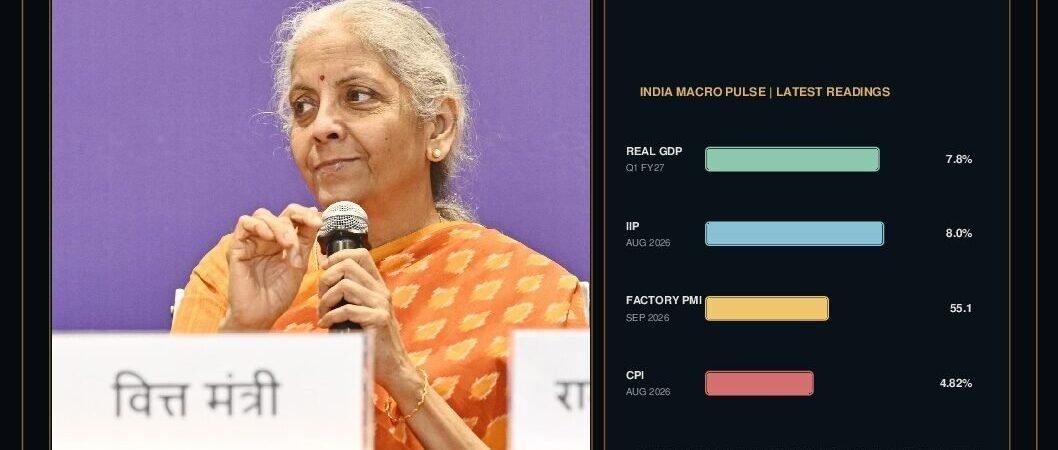
India is confronting simultaneous monetary tightening and tax-compliance reform. The RBI raised its policy repo rate by 25 basis points to 5.50% on 7 October and announced additional foreign-exchange and liquidity measures. On 8 October, the GST Council recommended changes addressing refunds, registration and compliance. Industrial output rose 8.0% year on year in August, and September manufacturing PMI was 55.1. The Nifty 50 and Sensex ended an eight-week losing sequence with weekly gains of 0.44% and 0.78%, respectively. Economic resilience should not be mistaken for immunity from higher funding and import costs.
02 | Headline Analysis: Two Policy Directions
The policy decisions operate through different channels. Higher rates restrain borrowing and reinforce inflation expectations; GST administration reform can improve working-capital efficiency if the recommendations become operative. The GST Council’s decisions should not be represented as implemented law before the necessary notifications. Imported energy, foreign-exchange conditions and borrowing costs remain the transmission routes to corporate margins, consumer prices and valuations. A single positive equity week is not definitive evidence of normalization.
03 | Markets & Macro Dashboard
Nifty 50 closed 9 October at 22,520.45; the BSE Sensex closed at 72,472.33. The onshore rupee finished at 96.73 per US dollar. The Indian 10-year benchmark yield stood at 7.2994%, while Brent settled at $104.72 per barrel. The most recently cited RBI foreign-exchange reserves were $734.60 billion for the week ended 2 October. These values describe different observation dates and must not be read as live Sunday quotes.
Market data at a glance
| Indicator | Latest reading | Observation date | Interpretation |
|---|---|---|---|
| Nifty 50 | 22,520.45 | 9 Oct 2026 close | 0.44% weekly gain |
| BSE Sensex | 72,472.33 | 9 Oct 2026 close | 0.78% weekly gain |
| USD / INR | 96.73 | 9 Oct 2026 onshore close | Later FX measures announced separately |
| India 10-year yield | 7.2994% | 9 Oct 2026 benchmark | Government bond yield |
| Brent crude | $104.72/bbl | 9 Oct 2026 settlement | Futures, not a Sunday live quote |
| Foreign exchange reserves | $734.60bn | Week ended 2 Oct 2026 | Lagged official reserve stock |
| Industrial production | +8.0% YoY | August 2026 | Quick estimate |
| Manufacturing PMI | 55.1 | September 2026 | Diffusion index, not growth rate |
04 | Global Economy & Geopolitics
Gulf conflict and storm-related production disruptions in the United States kept energy supply risks elevated. India’s crude import exposure runs beyond benchmark oil: freight, insurance, currency and funding affect landed costs. The RBI’s announced special dollar window for three state-owned oil-marketing companies, commencing 12 October, is designed to redirect some spot dollar demand; it does not cancel the underlying oil import bill. The key question is whether delivered fuel costs and shipping conditions stabilize.
05 | India Macro & Liquidity Radar
The monetary policy committee’s 7 October action lifted the repo to 5.50%, with the standing deposit facility at 5.25% and marginal standing facility and Bank Rate at 5.75%. The RBI also announced open-market bond sales worth Rs 250 billion and changes to the daily minimum cash reserve maintenance requirement from 16 October. Monetary policy rates, liquidity absorption and currency intervention must be assessed separately. August CPI inflation was 4.82%; September inflation data were scheduled for 12 October, after this issue’s cutoff.
06 | Rules, Policy & Release Calendar
The near-term calendar is material: September CPI was scheduled for 12 October, the oil-company dollar window was due to begin the same day, higher cash-reserve maintenance from 16 October, and MPC minutes on 21 October. The policy mix should be monitored against reserve valuations, bond-auction demand, business credit and inflation breadth.
07 | Research & Data Brief
The data do not measure the same underlying phenomenon. August industrial production was up 8.0%; manufacturing output rose 9.0%, while mining contracted 5.6%. Consumer durables rose 11.1% and non-durables 2.1%. September manufacturing PMI reached 55.1. September domestic GST growth was 10.1%. These observations provide evidence of activity and revenue collection, not interchangeable measures of real household consumption. The $12.95 billion weekly reserve fall includes valuation and transaction effects and is not a direct measure of intervention.
08 | Company Research Lab: Tata Consultancy Services
TCS disclosed its Q2 FY27 results on 8 October. Quarterly revenue was US$7.642 billion, sequential constant-currency growth 0.5%, international revenue growth 1.2% on the same basis, total contract value US$9.6 billion, operating margin 24.0%, annualised AI revenue US$3.1 billion and operating cash flow US$1.48 billion, equivalent to 102.2% of net income. The earnings analysis distinguishes contract bookings from recognized revenue, cash conversion from accounting earnings and AI revenue from any guaranteed investor return.
09 | Global-to-India Transmission
Different businesses absorb the same global shock differently. The net effects depend on import intensity, hedges, client contracts, debt maturities and pricing power. A weaker rupee can improve translation for some exporters but raise costs for importers; higher yields can affect capital-intensive businesses before current order books change. TCS offers an example of why operating cash generation and constant-currency revenue merit attention alongside headline turnover.
10 | Signals, Risks & Scenario Matrix
The issue assigns editorial monitoring weights to three cases rather than statistical probabilities: resilience under tighter financing (45%), imported-cost pressure weakening demand (35%), and relief through calmer foreign exchange and better cash conversion (20%). Key falsification tests include landed energy costs, inflation breadth, government-bond demand, order trends and cash-flow evidence. These weights are an editorial organizing device, not personalized investment recommendations.
11 | Continuity, Revisions & Forward Intelligence
Issue 004 argued that firm industrial activity could coexist with tighter financial conditions. The 7 October policy-rate increase confirmed the approaching test, while the 9 October equity rebound and the additional tax-compliance proposals introduced countervailing developments. As of the 11 October 11:00 IST research cutoff, the next published releases and policy implementation details remained forward-looking watchpoints.
Week ahead: scheduled events
- 12 October: September CPI release scheduled. Monitor inflation breadth.
- 12 October: Oil-company dollar window planned to begin. Assess currency liquidity.
- 16 October: Higher daily CRR maintenance requirement takes effect.
- 21 October: MPC minutes scheduled. Examine voting and policy rationale.
These were forthcoming events at the issue cutoff, not confirmed subsequent outcomes.
12 | ALBORITHM Bottom Line
India’s output buffer remains firm, but its financial environment has tightened. The RBI is acting through rates, cash liquidity and the dollar market while the GST Council is seeking administrative improvements. Sustainable relief requires more favorable landed energy prices, orderly currency and bond markets, and improvements in actual business cash generation. The equity recovery is a signal, not a verdict.
Sources, credits and evidence
The complete 12-page edition includes the detailed source register [S1] to [S22], dated market observations, supporting tables and event photography credited to the Press Information Bureau. Market prices refer to the observation dates shown and are not live quotes.
WATCH & LISTEN TO THIS ISSUE
The weekly explainer and English, Hindi and Bengali podcast editions will be linked here when available.
EXPLORE ALL NEWSLETTERS | VISIT ALBORITHM | SUBSCRIBE
For information and education only. Not investment advice. Research cutoff: 11 October 2026, 11:00 IST.
Subscribe to alborithm
Get new documentaries, articles and podcasts directly in your inbox.